---
title: Byens længste bindingsværk
description: Historien om Køges længste bindingsværk
---
[Skip to content](https://mystoryplace.dk/en/111#main-content)
[](https://mystoryplace.dk/?hsLang=en)
- [Bliv et Story Place](https://mystoryplace.dk/priser)
- [For byer og områder](https://mystoryplace.dk/for-byer)
- [Sådan fungerer det](https://mystoryplace.dk/sådan-virker-det)
- [Om My Story Place](https://mystoryplace.dk/om-my-story-place)
- [Kontakt](https://mystoryplace.dk/kontakt)
- [Bliv et Story Place](https://mystoryplace.dk/priser)
- [For byer og områder](https://mystoryplace.dk/for-byer)
- [Sådan fungerer det](https://mystoryplace.dk/sådan-virker-det)
- [Om My Story Place](https://mystoryplace.dk/om-my-story-place)
- [Kontakt](https://mystoryplace.dk/kontakt)
English
- [Deutsch](https://mystoryplace.dk/de/111)
- [Dansk - Danmark](https://mystoryplace.dk/111)
- [English](https://mystoryplace.dk/en/111)
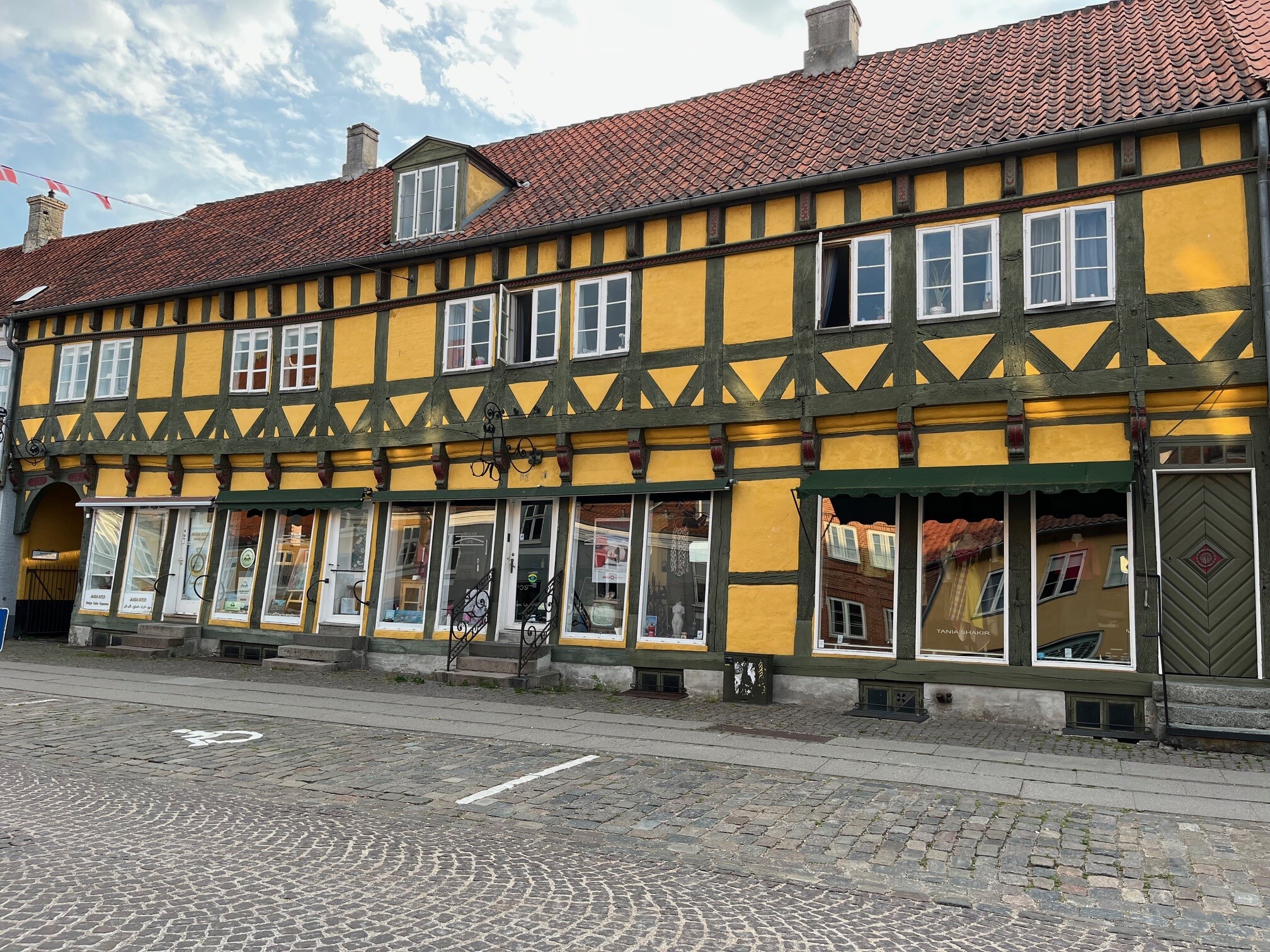
## The Longest Half‑Timbered Building
In 1633, a devastating fire swept through the town. Køge was in flames. Houses disappeared. After the great fire of 1633, which destroyed large parts of Brogade, Mayor Hans Christensen bought Brogade 16 and the neighbouring plot and built a large double farmstead, completed in 1636. This is the beautiful and well‑preserved property we know today.
With its 18 bays, the building is now one of the longest half‑timbered houses in Denmark. It is easy to imagine the impression it must have made at the time: long, striking, and impossible to overlook. A house that signalled both status and determination. It was built as a statement. The town was to be rebuilt. Life had to continue, and trade had to flourish again.
[Experience history and Shopping in Køge](https://www.visitkoege.dk/oplevelser)
## A Symbol of a Town Rising Again
It was considered a “speculative building project”, since Hans Christensen never lived in the house himself — it was built to be sold. Above the gateway, you can still see a carved wooden bracket with the initials HCKHD, referring to the builder Hans Christensen (Humble) and his wife Karen Hansdatter. The impressive building is not only a half‑timbered house but a symbol of a town that rose again.
The property still has its original oak timber framing across all 18 bays. The building also still retains the single dormer on the roof, making the resemblance between past and present striking. Today, the timber is highlighted with contrasting paint. In the past, both timber and plaster were limewashed in the same colour, as it was easier and cheaper to maintain.
[Visit Køge Miniby and step closer to history](https://www.visitkoege.dk/koege/oplevelser/opdag-de-finurlige-historier)
### Mores stories from Køge
[](https://mystoryplace.dk/en/18?hsLang=en)
**Køge's Smallest House**
[](https://mystoryplace.dk/16?hsLang=en)
**Danmarks ældst fungerende rådhus**
[](https://mystoryplace.dk/13?hsLang=en)
**Fra Købmandsgård til Museum**
#### My Story Place ApS
[+45 23 60 50 39](tel:+4523605039)
[info@mystoryplace.dk](mailto:info@mystoryplace.dk)
CVR: 37905224
[Terms of Service](https://26830004.hs-sites-eu1.com/terms-of-service?hsLang=en)
[](https://mystoryplace.dk?hsLang=en)
Gemte fortællinger
-
-
-
#### Links
[Forside](https://26830004.hs-sites-eu1.com/forside?hsLang=en)
Bevar historien
[Projektaftale](https://26830004.hs-sites-eu1.com/produkter-og-service?hsLang=en)
[Om My Story Place](https://26830004.hs-sites-eu1.com/om-my-story-place?hsLang=en)
[Kontakt](https://26830004.hs-sites-eu1.com/kontakt?hsLang=en)
[Login](https://profil.mystoryplace.dk/)
Copyright © 2023 My Story Place ApS All Rights Reserved.
[Privatlivspolitik |](https://mystoryplace.dk/privatlivspolitik?hsLang=en) [Cookiepolitik](https://mystoryplace.dk/cookiepolitik?hsLang=en)